Brooke Borcherding grew up in Southern California and earned a BFA in painting from the University of Oregon in 2010 — though she considers herself self-taught as a landscape painter, because the practice she built was not the practice the academic program was teaching. She took her easel outdoors for the first time in 2009, a year before she graduated, and has been painting from life ever since. The discipline came from standing in front of subjects with other plein air painters and learning from what they saw. She now works out of Wallingford in Seattle.
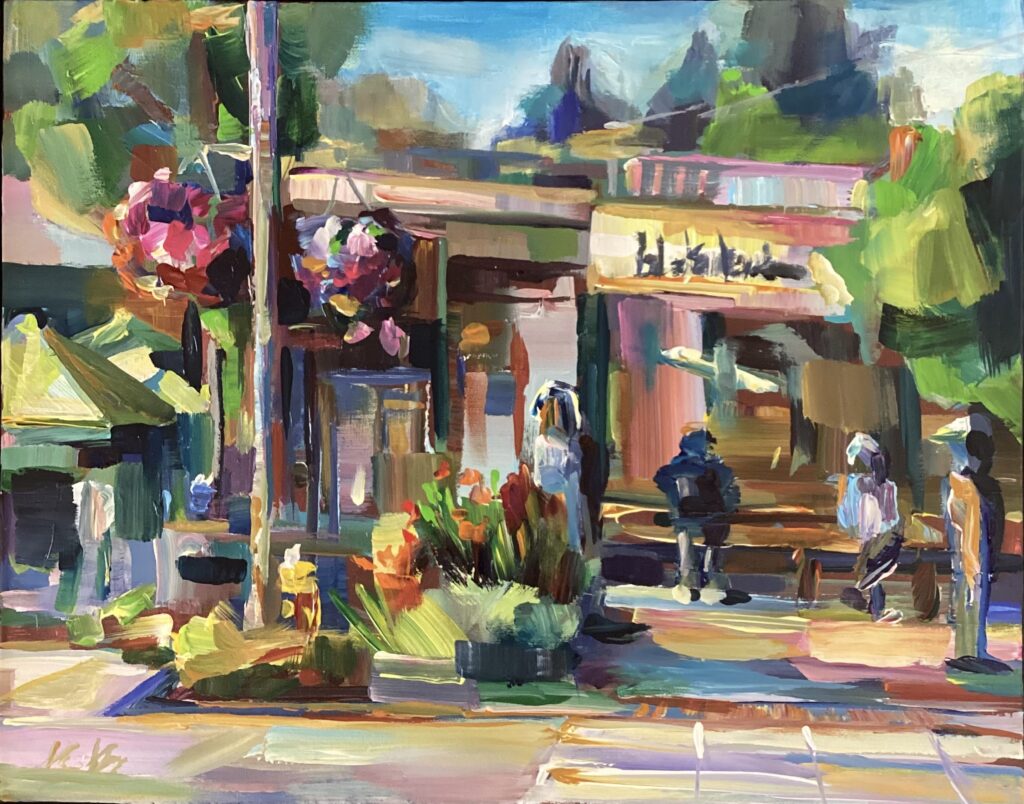
In Last Light, the painting constructs an urban street in aggressive blocks of cadmium yellow, alizarin crimson, ultramarine, and viridian, each hue applied in thick, deliberate strokes that flatten the scene into competing planes rather than receding space. Paint sits visibly on the canvas surface—the artist doesn't blend but instead stacks colors adjacent to one another, creating a frenetic, almost digital fragmentation where a parked car and distant traffic become equally vivid rectangular shapes. The composition pushes the viewer uncomfortably close to the street itself, with the horizon line pushed high and distorted, so that the sky's soft blue reads as mere backdrop to the chromatic chaos below. The work risks overwhelming its own subject through pure color intensity, suggesting that technical virtuosity in paint handling can paradoxically distance us from the ordinary scene it represents. Her paintings are called deconstructions. The landscape — a marina, a stand of trees, a city street — is broken into cascading blocks of color: brilliantly saturated, slightly pixelated, the image resolved from pure color relationships rather than from literal rendering. The approach is indebted to Richard Diebenkorn’s color structures, Wayne Thiebaud’s formal compression, and Chuck Close’s systematic treatment of surface — painters she names as formative. What she has made from these influences is something distinctly her own: the Pacific Northwest city and landscape refracted through a grid of warm, specific color.
Southwest Art selected her as one of 21 Artists Under 31 in 2016. Plein Air Magazine featured her urban plein air work in September 2022. American Art Collector published her in 2019. At the 2018 Carmel Plein Air Competition she won best oil and acrylic. Two of her early paintings — made when she was still a student — entered the University of Oregon permanent collection. She is nationally and internationally collected and is a member of Plein Air Painters of Washington.
My deconstructions aim to shed light on the beauty of ordered chaos — to stimulate our senses by exaggerating the color and space we see around us. I focus on broken color, giving a slight pixelated feel to familiar environments while maintaining a lively sense of dynamic energy.